Kaleidoscopes: Selection, Uses and Display Guide
Compare kaleidoscopes by viewing style, chamber, controls, length and presentation for a considered gift or retail assortment.
Compare moving liquid chambers with bead, wheel and other non-liquid kaleidoscope designs by motion, handling and care.
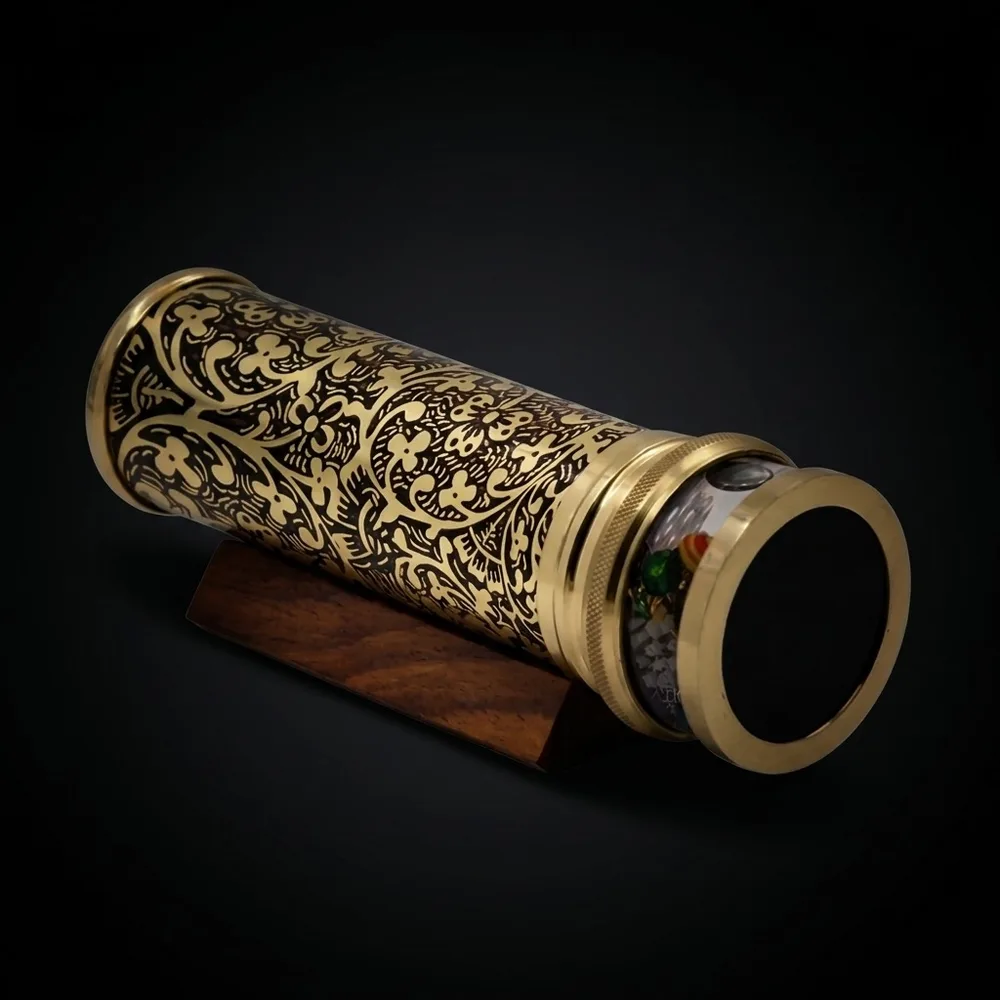
The difference between liquid and non-liquid kaleidoscopes is easiest to understand by watching how their image changes. In a liquid-chamber model, suspended elements drift as the instrument is tilted. In non-liquid versions, a turn may shift loose pieces, rotate a wheel or present a fixed arrangement in a new orientation. The viewer’s sense of pace and control is different, so a sample demonstration is more useful than a broad claim about which design is “better.”
Antiqula’s FlowX 7.0.0 is listed as a 7-inch brass kaleidoscope with a sealed liquid oil chamber, three-mirror system and hardwood display stand. For comparison, PrismX 6.0.1 lists lampwork glass beads and a hardwood stand, while PrismX 6.0.0 has an etched brass body, detachable tripod stand and fitted wooden box. Those records support a concrete comparison of motion and presentation; they do not identify the liquid’s chemistry.
As the viewer tilts a sealed liquid chamber, its contents move gradually rather than tumbling freely. That can create a slower, continuously shifting image that rewards patient observation. A retailer can demonstrate the effect by holding the barrel steady, then changing its angle gently. Let the chamber settle before turning again so the customer can see how movement changes the pattern.
Keep product language close to the listing. “Sealed liquid oil chamber” is the specified description for FlowX 7.0.0. Do not guess the liquid ingredients, claim that it is non-toxic or suitable for children, or suggest that the chamber can be opened and serviced. If a buyer needs a material safety or age statement, request documentation for the precise item. A sealed chamber is a design feature, not evidence of a particular formulation.
Non-liquid designs are not one single format. The PrismX 6.0.1 listing identifies lampwork glass beads and a three-mirror system. A different model may use loose pieces, a turning wheel, interchangeable objects or an open teleidoscope end. Each produces a different pattern and control. Check the specific product description before calling a model “bead-filled” or “wheel-driven.”
A wheel gives the user a direct control to turn; a bead or loose-piece chamber may respond to rotating or tilting the scope. Those actions make non-liquid designs engaging for a hands-on demo, but moving parts should be treated gently. The PrismX 6.0.0 listing describes a detachable tripod stand and fitted box rather than a moving chamber. That is a presentation-led distinction, useful to a buyer who values storage and display alongside viewing.
| Consideration | Liquid chamber | Non-liquid chamber or controls |
|---|---|---|
| Motion | Suspended elements drift as the scope tilts | Pieces shift or wheels rotate according to the model |
| Demonstration | Move slowly and allow the pattern to settle | Show the stated turning or tilting action without force |
| Care | Keep the sealed chamber intact; do not open or refill | Protect glass, beads and controls from impact or rough handling |
| Buyer question | Does a gradual change in image appeal? | Which specific control or object chamber is included? |
The choice is partly sensory. A person who enjoys a measured, fluid shift may prefer a liquid chamber. Someone who wants a visible hand-operated control may respond more to a turning wheel. A fixed or simply rotating object chamber can be suitable when the recipient wants a straightforward instrument. There is no universal ranking: demonstrate both with similar light and viewing conditions, then let the buyer compare.
Use a stable counter, enough ambient light and one model at a time. Explain where to look and how to move the instrument. Do not spin a scope quickly to create a more dramatic effect; the goal is to represent ordinary use. Keep the eyepiece clean and avoid touching the optical surfaces. If children are present, follow the product’s own age and supervision information rather than inferring suitability from appearance.
For an online listing, describe the mechanism in plain terms and show an actual pattern if possible. Do not rely on a generic animation that suggests a feature the model does not have. List the scope length, mirror arrangement, chamber type and included stand or box as specified. If an accessory appears only in a lifestyle photograph, clarify that it is not included unless the product record says so.
The catalogue examples show why packaging deserves its own comparison. FlowX 7.0.0 is listed with a hardwood stand; PrismX 6.0.1 also lists a hardwood stand; PrismX 6.0.0 lists a detachable tripod and fitted wooden box. A stand keeps an instrument visible but needs shelf space. A fitted box makes storage more contained and may suit gifting. Confirm that those inclusions are current for the selected stock.
Brass surfaces can vary in finish. The Canadian Conservation Institute warns that polishing is abrasive and may remove metal and surface detail. Follow model-specific guidance, dust carefully and do not use a metal polish on the eyepiece, stand or any chamber. The practical choice follows the recipient: gradual fluid motion, an interactive bead or wheel format, or a simpler presentation-led scope. State the features accurately and the difference becomes clear without overstating performance.
Catalogue reference: FlowX 7.0.0. Listed material: Brass.
Check the current product page and ask for model-specific dimensions, packaging and suitability before ordering.
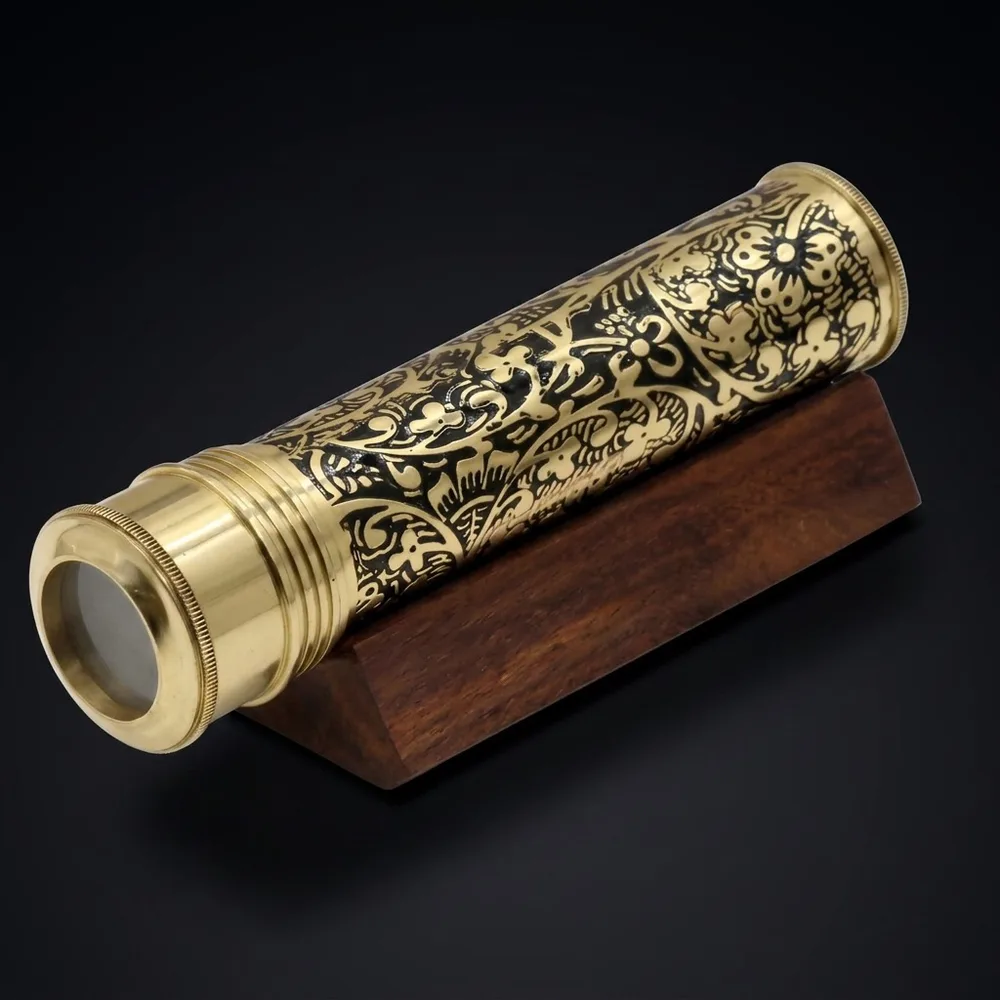
Catalogue reference: PrismX 6.0.0. Listed material: Brass.
Check the current product page and ask for model-specific dimensions, packaging and suitability before ordering.
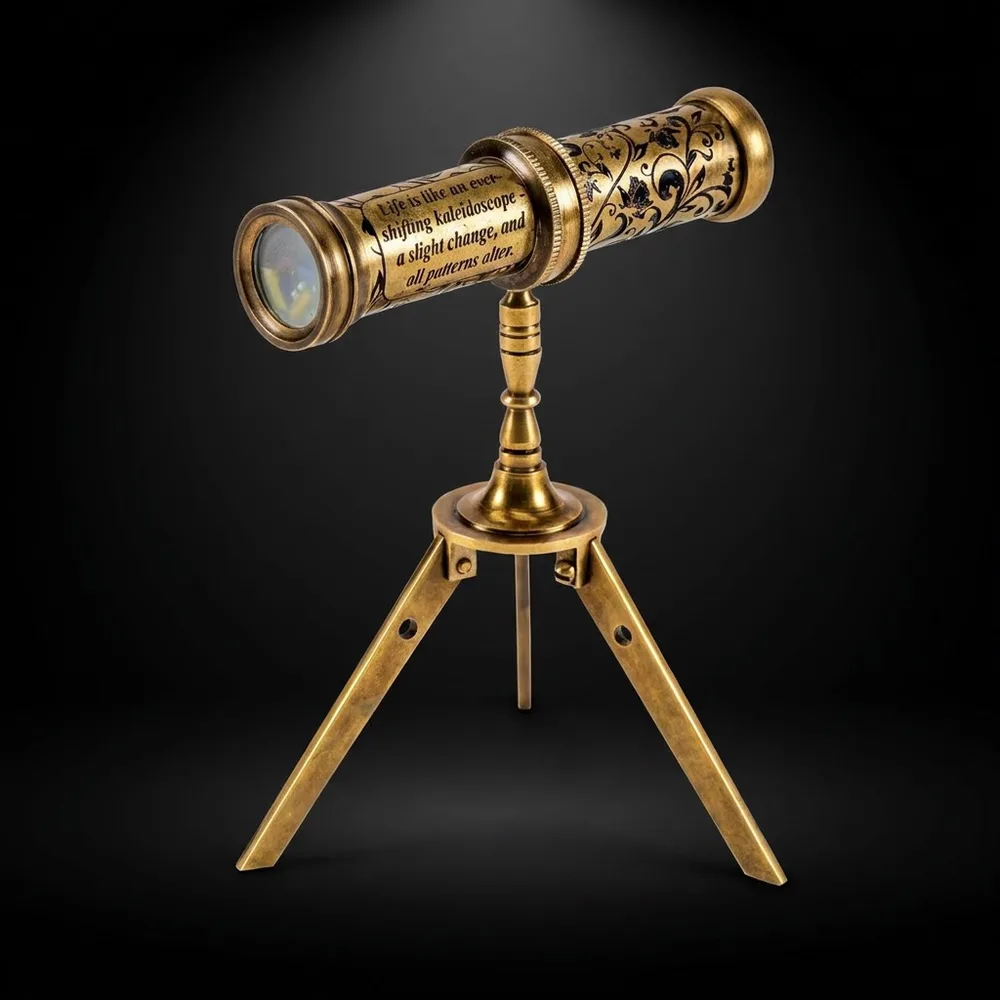
Catalogue reference: PrismX 5.0.3. Listed material: Brass.
Check the current product page and ask for model-specific dimensions, packaging and suitability before ordering.
Explore Antiqula’s kaleidoscopes catalogue
Catalogue examples were checked against Antiqula’s product records on 2026-10-02. Research sources provide context; they do not certify the performance of individual catalogue products.